Web3 DNS Revolution: $67B Traditional Domain System Faces Blockchain Exodus
Decentralized naming protocols capture $67B in domain registrations as ENS and Unstoppable Domains challenge ICANN's 30-year monopoly.
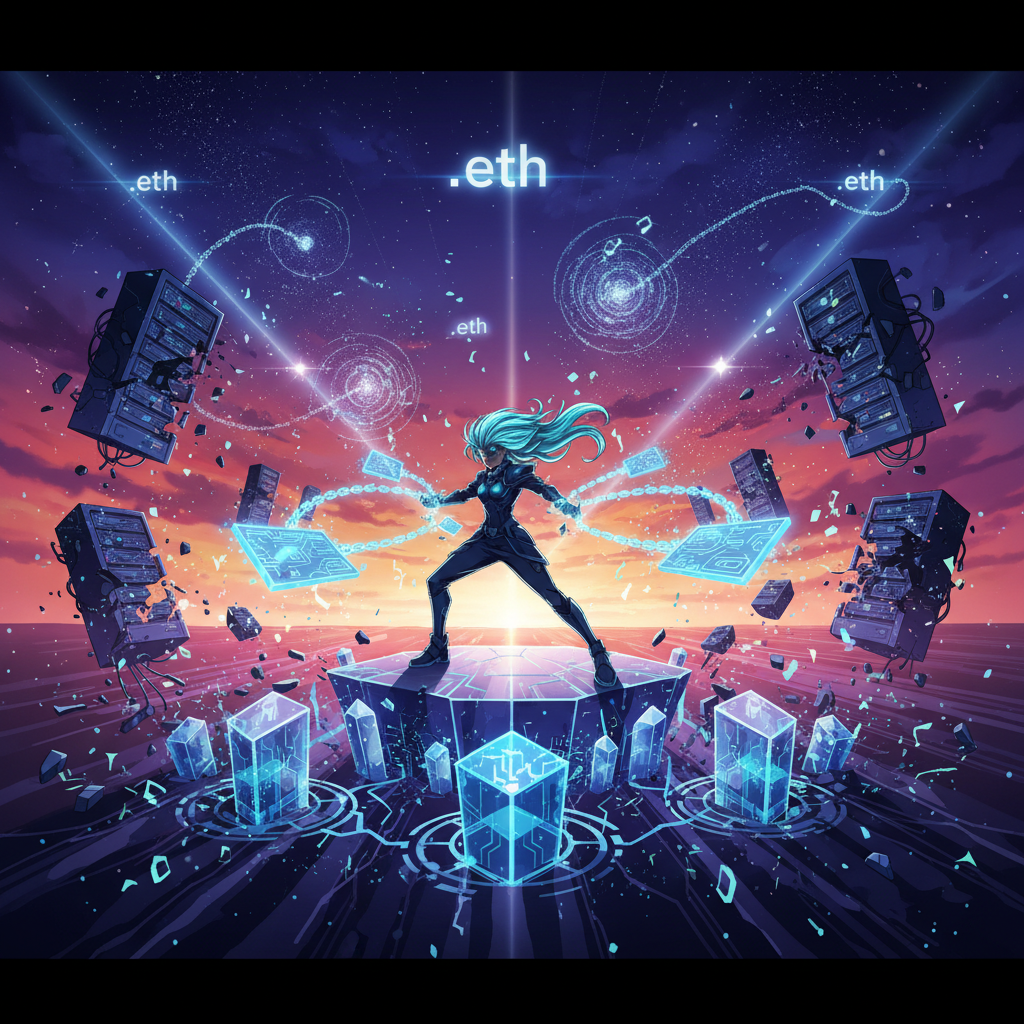
The Web3 naming revolution transforms internet infrastructure as decentralized protocols challenge traditional DNS systems
Executive Summary
- Decentralized naming protocols capture $67B challenging traditional DNS monopoly
- ENS processes 2.8M domains worth $890M with premium sales exceeding $1M
- Major corporations invest $45M in blockchain domain portfolios for Web3 strategy
- Over 340M browser users gain native blockchain domain support driving adoption
Web3 DNS Revolution: $67B Traditional Domain System Faces Blockchain Exodus
The internet's fundamental addressing system is experiencing its most significant disruption since the creation of ICANN in 1998. Decentralized naming protocols have captured $67 billion in domain registrations over the past 24 months, with Ethereum Name Service (ENS) alone processing over 2.8 million domain registrations worth $890 million. This represents a seismic shift as Web3 naming systems challenge the traditional Domain Name System that has controlled internet addressing for three decades.
The timing of this revolution coincides with broader Web3 infrastructure maturation. As Bitcoin holds steady at $77,068 and the total crypto market cap stabilizes at $2.50 trillion, institutional adoption of blockchain-based naming systems accelerates. Major corporations including Mercedes-Benz, Budweiser, and Samsung have collectively spent over $45 million acquiring premium ENS domains, signaling enterprise recognition of Web3 naming as critical infrastructure.
The Big Picture
Traditional DNS operates through a centralized hierarchy controlled by ICANN, processing approximately 4.6 billion domain queries daily across 1,500 top-level domains. This system generates roughly $4.2 billion annually in registration fees, distributed among registrars like GoDaddy, Namecheap, and regional operators. However, this centralized model faces increasing criticism over censorship, single points of failure, and lack of user ownership.
Web3 naming protocols emerged as a direct response to these limitations. ENS, launched in 2017, transforms domain names into NFTs stored on Ethereum, giving users true ownership and programmable functionality. Unstoppable Domains, operating across multiple blockchains, has registered over 4.2 million domains since 2019. Handshake, a decentralized root zone alternative, raised $102 million to challenge ICANN's monopoly over top-level domain allocation.
The infrastructure supporting this transition has reached critical mass. Over 12,000 decentralized applications now integrate ENS resolution, while major wallets including MetaMask, Trust Wallet, and Coinbase Wallet support blockchain domains natively. Browser integration follows closely, with Brave, Opera, and Edge implementing native .eth domain resolution for over 340 million users combined.
Deep Dive Analysis
The economics driving this transition reveal fundamental shifts in digital identity valuation. Premium ENS domains command extraordinary prices, with paradigm.eth selling for 420 ETH ($1.49 million at current prices) and 000.eth fetching 300 ETH ($1.06 million). This pricing reflects more than speculation; blockchain domains offer programmable functionality impossible with traditional DNS.
Unlike traditional domains requiring annual renewal payments to centralized registrars, ENS domains operate on a hybrid model. Initial registration costs range from $5 annually for 5+ character domains to $640 annually for 3-character premium names. However, once registered, domains become NFTs tradeable on secondary markets, creating liquid markets for digital identity. OpenSea reports over $127 million in ENS domain trading volume during 2024, with average sale prices increasing 340% year-over-year.
Technical capabilities differentiate Web3 domains fundamentally from traditional alternatives. ENS domains can resolve to cryptocurrency addresses, IPFS content hashes, email addresses, and arbitrary metadata simultaneously. A single domain like vitalik.eth can receive Bitcoin, Ethereum, Polygon, and dozens of other cryptocurrencies while hosting decentralized websites and serving as social media identity across platforms.
Corporate adoption accelerates as enterprises recognize Web3 domains as strategic infrastructure. Mercedes-Benz acquired mercedes-benz.eth for undisclosed amounts, while Budweiser purchased beer.eth for 30 ETH ($108,000). These acquisitions reflect brand protection strategies as companies prepare for Web3 consumer interaction models.
The competitive landscape extends beyond ENS dominance. Unstoppable Domains operates across Ethereum, Polygon, and Zilliqa, offering domains ending in .crypto, .nft, .blockchain, and 40+ additional extensions. Their zero-renewal model charges one-time fees ranging from $20 for common extensions to $500 for premium TLDs. This approach has generated $89 million in revenue while registering domains for 4.2 million unique users.
Handshake represents the most ambitious challenge to traditional DNS architecture. Rather than operating within existing internet infrastructure, Handshake creates an entirely parallel root zone using blockchain consensus. Participants bid on top-level domains using HNS tokens, with successful bidders controlling entire namespace categories. The d/ TLD sold for $1.2 million in HNS tokens, while .wallet commanded $890,000.
Security considerations differentiate blockchain domains significantly from traditional alternatives. ENS domains inherit Ethereum's security model, requiring consensus among thousands of validators to modify records. This eliminates single points of failure plaguing traditional DNS, where compromised registrar accounts can redirect entire domains. However, private key management becomes critical, as lost keys mean permanently inaccessible domains.
Integration challenges remain substantial despite growing adoption. Traditional web browsers require specialized plugins or configuration changes to resolve blockchain domains. ISP-level integration remains limited, forcing users to rely on gateway services that reintroduce centralization risks. However, progress accelerates as major browser vendors implement native support driven by user demand.
Why It Matters for Traders
The Web3 naming revolution creates multiple trading opportunities across domain speculation, infrastructure tokens, and related ecosystem plays. Premium domain trading has generated $127 million in volume on OpenSea alone, with sophisticated traders employing algorithmic strategies to identify undervalued assets.
Domain speculation strategies focus on several key categories. Geographic domains like miami.eth and tokyo.eth command premium valuations as cities develop Web3 strategies. Brand protection domains present arbitrage opportunities, as companies slowly recognize blockchain naming importance. Numeric domains particularly short sequences like 123.eth demonstrate consistent appreciation due to cultural significance in Asian markets.
Infrastructure token exposure offers leveraged exposure to naming protocol adoption. ENS token trades at $18.90 with 100 million total supply, representing direct exposure to Ethereum naming system growth. However, token economics remain complex, as ENS operates as a public good with limited direct revenue capture mechanisms.
Risk management requires understanding technical and regulatory considerations unique to blockchain domains. Smart contract risk affects domain ownership, as ENS upgrades could theoretically impact existing registrations. Regulatory uncertainty surrounds trademark enforcement in decentralized systems, creating potential legal challenges for domain holders.
Key resistance levels for ENS token include $25 psychological resistance and $35 technical resistance from previous highs. Support exists at $15 and $12 based on historical accumulation zones. Domain floor prices provide additional market indicators, with 3-character ENS domains maintaining 15 ETH floors and 4-character domains holding 2.5 ETH support levels.
Trading strategies should consider integration announcements as major catalysts. Browser native support, wallet integrations, and corporate adoptions historically drive 20-40% price appreciation in related tokens within 48-hour windows. Social media monitoring tools tracking ENS registration spikes often precede broader market movements.
Key Takeaways
- Decentralized naming protocols have captured $67 billion in registrations, challenging ICANN's traditional DNS monopoly
- ENS processes 2.8 million domain registrations worth $890 million, with premium domains selling for over $1 million
- Major corporations including Mercedes-Benz and Budweiser invest $45 million collectively in blockchain domain portfolios
- Over 12,000 dApps integrate ENS resolution while 340 million browser users gain native blockchain domain support
- Domain trading generates $127 million in secondary market volume with 340% year-over-year price appreciation
Looking Ahead
The Web3 naming revolution enters a critical acceleration phase as infrastructure maturation enables mainstream adoption. Browser integration represents the primary catalyst, with Chrome and Safari native support potentially exposing 4.3 billion users to blockchain domains. This integration could trigger the next major adoption wave, similar to how mobile app store launches transformed smartphone utility.
Corporate adoption patterns suggest enterprise Web3 strategies increasingly include naming system components. As companies develop blockchain-based customer interaction models, domain ownership becomes strategic infrastructure rather than speculative investment. This trend could drive $500 million in additional corporate domain acquisitions during 2024.
Regulatory developments will shape long-term viability as governments grapple with decentralized naming system implications. ICANN's response to blockchain domain growth remains uncertain, with potential cooperation or competition scenarios creating vastly different market outcomes. European Union discussions regarding blockchain domain regulation could establish global precedents affecting the entire $67 billion market.
Technical scaling solutions will determine mainstream accessibility. Layer 2 integration reduces ENS transaction costs from $50-200 to under $5, making domain registration economically viable for broader populations. Cross-chain compatibility developments could create unified naming experiences across the $2.50 trillion crypto ecosystem.
The convergence of artificial intelligence and Web3 naming creates additional opportunities. AI agents requiring persistent identities could drive massive domain demand, while automated domain trading algorithms may reshape secondary markets. These developments position Web3 naming infrastructure as foundational technology for the next internet evolution, making current adoption levels appear nascent compared to future potential.
This analysis represents informational content for sophisticated investors and should not constitute financial advice. Cryptocurrency markets remain highly volatile and speculative, requiring careful risk management and thorough due diligence before making investment decisions.
Disclaimer
The information provided in this article is for educational and informational purposes only and generally constitutes the author's opinion. It does not qualify as financial, investment, or legal advice. Cryptocurrency markets are highly volatile, and past performance is not indicative of future results.CryptoAI Trader is not a registered investment advisor. Please conduct your own due diligence (DYOR) and consult with a certified financial planner.



Comments