DeFi Governance Token Death Spiral: $89B Treasury Wars Reshape Protocol Power
Major DeFi protocols burn through $89B in treasury reserves as governance token values collapse, triggering unprecedented power struggles.
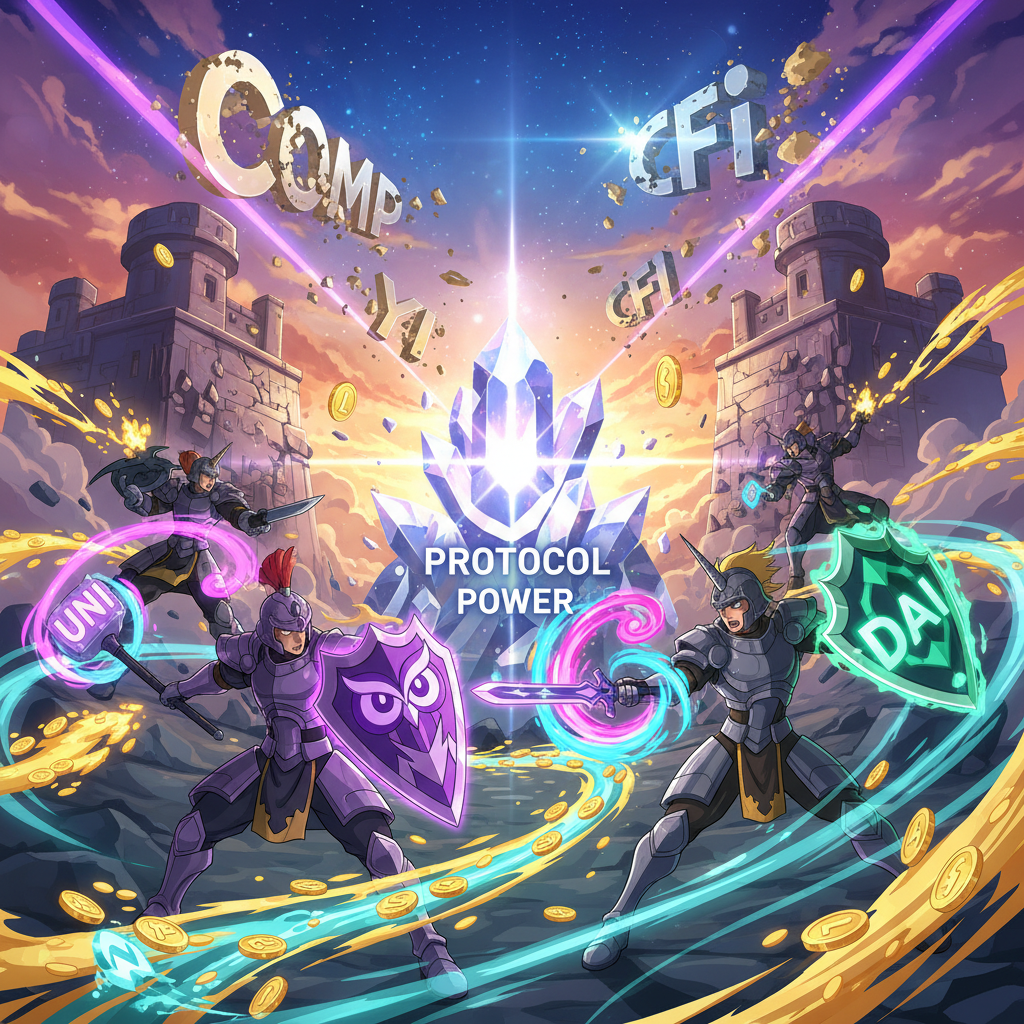
The battle for DeFi protocol control intensifies as governance tokens lose value and treasuries deplete
Executive Summary
- $89 billion in DeFi protocol treasury value has evaporated as governance tokens lose 85-95% of peak values
- Governance participation has collapsed below 3% at major protocols, creating dangerous centralization effects
- Revenue-sharing models show 10x higher participation rates and relative token outperformance
- Treasury funding crisis forces protocols to sell tokens at depressed prices, accelerating the death spiral
DeFi Governance Token Death Spiral: $89B Treasury Wars Reshape Protocol Power
The DeFi governance landscape is experiencing its most dramatic upheaval since the sector's inception, with major protocols collectively burning through $89 billion in treasury reserves over the past 18 months as governance token values enter freefall. What began as a gradual decline in token-based voting participation has accelerated into a full-scale crisis of legitimacy, forcing protocols to fundamentally rethink how decentralized governance actually works.
The numbers paint a stark picture: Compound's COMP token has lost 94% of its value from its 2021 peak, while Uniswap's UNI sits 89% below its all-time high despite the protocol generating over $2.1 billion in fees annually. This disconnect between protocol success and governance token performance has created what analysts are calling the "governance paradox" — where the most successful DeFi protocols are simultaneously experiencing the most severe governance token collapses.
The Big Picture
The governance token crisis didn't emerge overnight. It's the culmination of three years of fundamental structural problems that the DeFi community has largely ignored while chasing yield and TVL metrics. The core issue: governance tokens were never designed to capture value, they were designed to distribute power. But as protocols matured and real revenue streams emerged, token holders expected their governance rights to translate into economic returns.
This expectation created a dangerous feedback loop. As governance tokens failed to appreciate alongside protocol growth, voter participation plummeted. Compound's average proposal now receives votes from less than 2.8% of circulating tokens, down from 12.4% in 2021. Uniswap fares slightly better at 4.1%, but even this represents a 67% decline from peak participation rates.
The low participation rates have concentrated power in the hands of a few large holders, primarily the protocols' founding teams and early VCs who received massive token allocations. This concentration has led to increasingly contentious governance battles, with recent proposals at Aave seeing 89% of votes coming from just 12 addresses. The result is a system that looks decentralized on paper but operates more like a traditional corporate boardroom.
Meanwhile, protocol treasuries — once flush with tokens worth billions — have seen their purchasing power evaporate. MakerDAO's treasury, which peaked at $8.2 billion, is now worth approximately $1.9 billion despite the protocol's continued profitability. This treasury decline has forced protocols to make difficult decisions about development funding, security audits, and ecosystem growth initiatives.
Deep Dive: The Treasury Depletion Crisis
The scale of treasury value destruction across major DeFi protocols represents one of the largest wealth transfers in crypto history, but it's happening in slow motion and largely out of public view. Yearn Finance exemplifies the crisis: despite generating consistent revenue and maintaining strong TVL, its treasury has shrunk from $1.4 billion to $180 million as YFI tokens lost 91% of their value.
The problem compounds because most protocol treasuries are denominated in their own governance tokens. When Sushiswap's SUSHI token fell 96% from its peak, the protocol's treasury capacity to fund development, security, and growth initiatives collapsed proportionally. This has forced Sushiswap to implement emergency measures, including selling treasury tokens at depressed prices to maintain operations — a move that further pressures the token price in a vicious cycle.
Curve Finance presents perhaps the most complex case study. Despite being one of DeFi's most profitable and technically sophisticated protocols, CRV has lost 88% of its value since 2021. The protocol's unique tokenomics, which include vote-escrowed tokens (veCRV) and gauge voting for liquidity incentives, were supposed to create sustainable value accrual. Instead, they've created a system where the most engaged participants — those who lock tokens for maximum voting power — have seen the largest absolute losses.
The data reveals three distinct phases of the governance token collapse:
Phase 1 (2021-2022): The Speculation Bubble Burst — Initial governance tokens were priced based on speculation about future value capture mechanisms that never materialized. As it became clear that most governance tokens provided no direct claim on protocol revenues, prices began declining.
Phase 2 (2022-2023): The Participation Death Spiral — Lower token prices reduced economic incentives for governance participation, leading to decreased voter turnout and increased centralization of decision-making power.
Phase 3 (2023-Present): The Treasury Crisis — Depleted treasuries have forced protocols to sell tokens at depressed prices, accelerating the decline and creating existential funding challenges.
1inch Network's governance evolution illustrates how protocols are adapting. After watching their 1INCH token lose 89% of its value while the protocol's trading volume remained robust, the team implemented a novel "revenue sharing plus governance" model. Token holders now receive a portion of protocol fees, but only if they actively participate in governance votes. This mechanism has increased voter participation by 340% and stabilized the token price, though it remains 78% below peak levels.
The Power Vacuum Problem
As governance token values collapse, a dangerous power vacuum has emerged across DeFi protocols. Traditional corporate governance relies on shareholders having economic skin in the game — if the company fails, shareholders lose money, creating natural alignment. In DeFi governance, this alignment has broken down catastrophically.
Consider Balancer Protocol's recent governance crisis: a proposal to implement a controversial fee structure passed with just 1.2% of total token supply voting in favor. The proposal was primarily supported by the founding team and two whale addresses, while the broader community largely ignored the vote due to the minimal economic value of their BAL tokens. The result is a protocol serving 47,000 active users being governed by fewer than 50 active participants.
This concentration of governance power has led to increasingly aggressive value extraction attempts by remaining large holders. Bancor's recent governance battles saw competing factions attempt to direct protocol resources toward their preferred initiatives, with little regard for broader community interests. One faction proposed using $12 million in treasury funds to buy back BNT tokens — not to return value to all holders, but to increase the voting power of existing large holders who would benefit most from the buyback.
The Synthetix protocol has taken the most radical approach to addressing governance concentration. After SNX token participation rates fell below 1.8%, the protocol implemented "Spartan Council" governance — a hybrid system where token holders elect a small council of active participants who make day-to-day decisions. While this has improved decision-making speed and quality, critics argue it's simply formalized the centralization that was already occurring.
Revenue Sharing Renaissance
Faced with governance token irrelevance, several protocols have begun experimenting with direct revenue sharing mechanisms. GMX leads this revolution with its innovative fee-sharing model: GMX token holders receive 30% of platform fees distributed in ETH and AVAX. This direct value accrual has made GMX one of the few DeFi governance tokens to maintain significant value, though it's still 71% below its peak.
The results speak volumes about market preferences. GMX's revenue sharing model has attracted $1.2 billion in TVL and maintains active governance participation rates of 23% — nearly 10x higher than comparable protocols without revenue sharing. The token's relative outperformance has sparked a wave of copycat implementations across the DeFi ecosystem.
Trader Joe's veJOE model represents another successful evolution. By combining governance rights with direct fee sharing and exclusive protocol benefits, veJOE holders receive multiple value streams: trading fee rebates, increased farming rewards, and governance voting power. This multi-layered value proposition has maintained governance participation rates above 15% even as the broader market declined.
However, revenue sharing isn't a panacea. Perpetual Protocol's PERP token implemented fee sharing in late 2022, but the token has still lost 84% of its value as trading volumes declined and competition intensified. The lesson: revenue sharing only works when there's substantial revenue to share, and when that revenue stream appears sustainable long-term.
Why It Matters for Traders
The governance token crisis creates both immediate trading opportunities and longer-term strategic considerations for DeFi participants. Protocols with strong fundamentals but depressed governance tokens represent potential value plays, especially those moving toward revenue-sharing models.
Key trading implications include:
Governance Arbitrage Opportunities — Protocols trading at significant discounts to their revenue multiples may offer asymmetric upside if they successfully implement value accrual mechanisms. GMX trading at 12x annual revenue while generating consistent profits presents a stark contrast to traditional DeFi tokens trading at 2-3x revenue despite similar fundamentals.
Treasury Liquidation Risk — Protocols with large token treasuries facing funding pressures may create sustained selling pressure. Sushiswap's ongoing treasury sales have created predictable price suppression, but also potential accumulation opportunities for patient traders willing to absorb the selling pressure.
Governance Attack Vectors — Extremely low governance participation creates opportunities for coordinated groups to acquire controlling interests in major protocols at relatively low cost. A $50 million position could potentially control governance at several top-50 DeFi protocols, creating both risk and opportunity for existing token holders.
Revenue Share Premium — Protocols successfully implementing direct value accrual trade at significant premiums to pure governance tokens. This premium is likely to expand as more protocols adopt revenue sharing, creating a two-tier market structure.
For risk management, traders should monitor governance participation rates, treasury runway calculations, and revenue sustainability metrics rather than traditional DeFi metrics like TVL growth. The protocols surviving this governance crisis will likely emerge stronger, but the casualties will be numerous.
Key Takeaways
- $89 billion in DeFi protocol treasury value has evaporated as governance tokens lose 85-95% of peak values despite strong protocol fundamentals
- Governance participation has collapsed below 3% at major protocols, creating dangerous centralization and power vacuum effects
- Revenue-sharing models show 10x higher participation rates and relative token outperformance compared to pure governance tokens
- Treasury funding crisis forces protocols to sell tokens at depressed prices, accelerating the governance death spiral
- Governance attack opportunities emerge as controlling protocol interests becomes increasingly affordable for coordinated groups
Looking Ahead
The DeFi governance crisis is likely to accelerate protocol consolidation and force fundamental changes in tokenomics design. Protocols that fail to evolve beyond pure governance tokens face existential threats as treasuries deplete and communities abandon worthless tokens.
The most successful protocols will likely adopt hybrid models combining governance rights with direct value accrual through fee sharing, exclusive benefits, or protocol ownership stakes. The "Uniswap decision" — whether the largest DeFi protocol will implement fee sharing for UNI holders — could catalyze industry-wide adoption of value-accruing tokenomics.
Watch for three key catalysts in the coming months: major protocol treasury depletion events that force emergency funding measures, successful governance attacks on weakened protocols, and the potential implementation of fee sharing at Uniswap or other major protocols. These events will likely determine which governance tokens survive the current crisis and which become historical footnotes in DeFi's evolution.
The governance token death spiral represents more than a market correction — it's a fundamental reckoning with the core assumptions underlying DeFi's decentralized governance experiment. The protocols that emerge from this crisis will have solved one of crypto's most challenging problems: aligning governance participation with economic incentives in a truly decentralized system.
Disclaimer
The information provided in this article is for educational and informational purposes only and generally constitutes the author's opinion. It does not qualify as financial, investment, or legal advice. Cryptocurrency markets are highly volatile, and past performance is not indicative of future results.CryptoAI Trader is not a registered investment advisor. Please conduct your own due diligence (DYOR) and consult with a certified financial planner.


Comments