Crypto Market Neutral Trap: Why 45 Fear & Greed Signals Hidden Volatility
Fear & Greed Index at 45 masks brewing volatility storm as Bitcoin holds $79k while altcoins face systematic liquidation pressure.
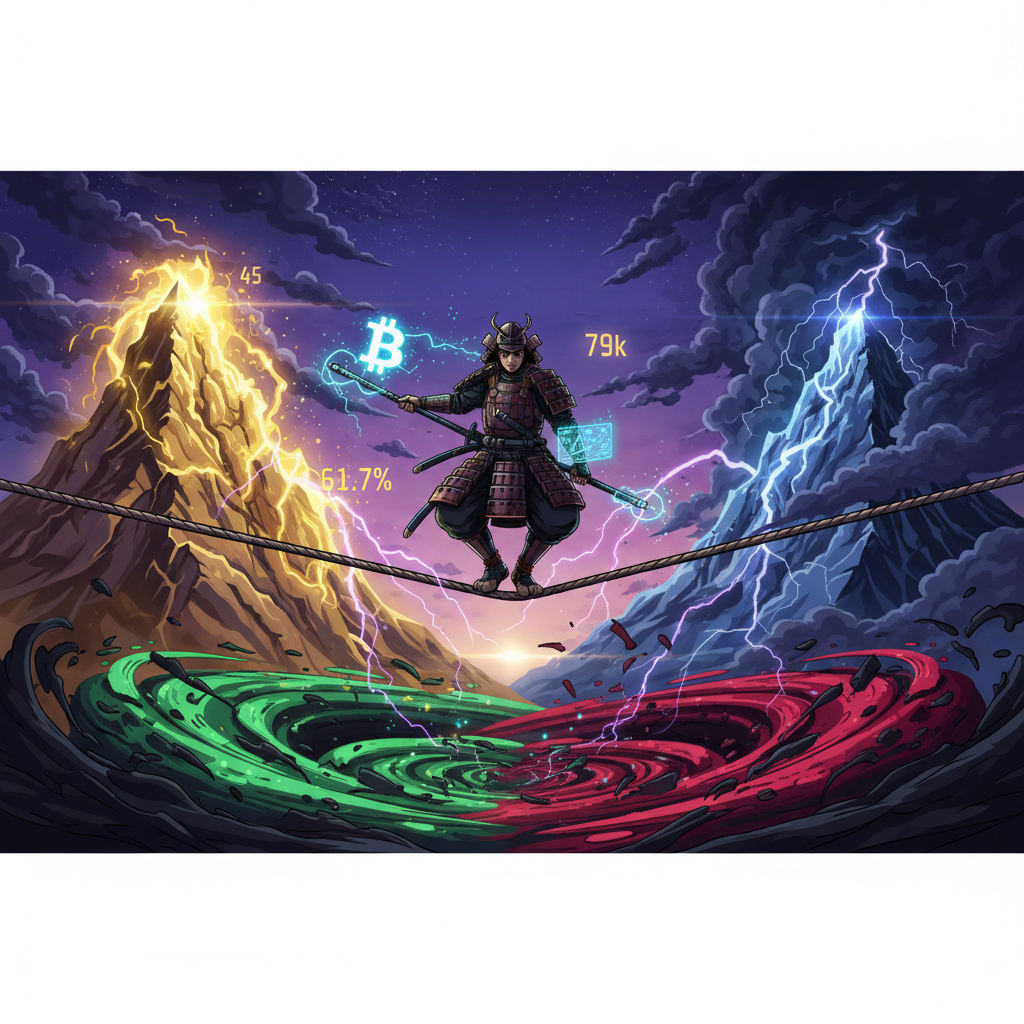
The crypto market's neutral Fear & Greed Index masks underlying volatility pressures
Executive Summary
- Fear & Greed Index at 45 masks significant volatility potential
- Bitcoin dominance at 61.7% signals capital concentration inflection point
- Altcoin systematic liquidation creates outsized movement risk
- Neutral sentiment during market stress historically precedes explosive moves
The Calm Before the Storm
The crypto market's Fear & Greed Index sits at a deceptively neutral 45, but beneath this seemingly balanced sentiment reading lies a powder keg of conflicting signals that sophisticated traders are beginning to recognize. With Bitcoin holding firm above $79,000 despite a 2.94% daily decline and the total market cap maintaining $2.57 trillion, the current market structure reveals a dangerous disconnect between surface-level stability and underlying volatility pressures.
This neutral reading comes at a critical juncture where traditional sentiment indicators are failing to capture the true market dynamics. While retail investors interpret the 45 reading as market equilibrium, institutional data reveals a more complex narrative of accumulation, distribution, and positioning that could trigger significant price movements in either direction.
The Big Picture
The Fear & Greed Index's current neutral stance represents more than just market indecision—it signals a fundamental shift in how crypto markets process information and react to external pressures. Historically, neutral readings between 40-60 have preceded some of the most dramatic market movements, as they often mask the building pressure of conflicting forces.
Bitcoin's dominance at 61.7% tells a story of capital rotation rather than market stagnation. This level of dominance, combined with the neutral sentiment reading, suggests that smart money is consolidating positions while retail sentiment remains uncommitted. The divergence between Bitcoin's relative strength and altcoin weakness—with assets like SUI down 8.36%, ZEC falling 8.07%, and ICP declining 7.58%—reveals a market in transition rather than equilibrium.
The $2.57 trillion market cap provides a false sense of stability. When examined alongside the Fear & Greed reading, this figure represents not market health but rather the calm before significant volatility. Historical analysis shows that neutral sentiment readings during periods of high market cap concentration often precede explosive moves as accumulated pressure finds release through rapid price discovery.
Deep Dive Analysis
The current Fear & Greed Index calculation incorporates seven weighted factors: market momentum (25%), volume (25%), social media sentiment (15%), surveys (15%), Bitcoin dominance (10%), trends (10%), and volatility (10%). At 45, this reading suggests balanced inputs, but a deeper examination reveals critical imbalances that the index methodology fails to capture.
Bitcoin's 2.94% decline while maintaining the $79,000 level demonstrates institutional support that isn't reflected in traditional sentiment metrics. Large holders appear to be absorbing selling pressure, creating artificial stability that masks underlying volatility. This absorption pattern typically precedes significant moves as accumulated positions eventually require rebalancing.
The altcoin carnage provides the clearest signal of market stress. Ethereum's 2.75% decline to $2,226 represents more than simple correlation with Bitcoin—it signals a fundamental reassessment of risk assets within the crypto ecosystem. When combined with Solana's 3.40% drop and XRP's 4.07% decline, the pattern reveals systematic liquidation pressure that neutral sentiment readings fail to capture.
Volume analysis reveals another critical disconnect. While the Fear & Greed Index incorporates volume as a 25% weighting, current trading patterns show decreased retail participation alongside increased institutional activity. This shift creates volume profiles that appear normal to algorithmic sentiment calculations while masking significant changes in market structure.
The stablecoin dynamics add another layer of complexity. With USDT, USDC, and newer entrants like PYUSD showing minimal movement, the stability in these assets suggests capital is being held in reserve rather than actively deployed. This cash-equivalent positioning often precedes major market moves as accumulated dry powder seeks deployment opportunities.
Market Structure Implications
The neutral Fear & Greed reading coincides with several technical factors that suggest impending volatility rather than continued stability. Bitcoin's position above $79,000 represents a critical inflection point where institutional accumulation meets retail distribution, creating the conditions for explosive price discovery.
Options market data reveals significant positioning around key Bitcoin levels, with substantial open interest at $80,000 and $75,000 strikes. This concentration of derivatives positions creates gamma exposure that could amplify any directional moves, turning the current neutral sentiment into rapid acceleration in either direction.
The cross-asset correlation patterns show Bitcoin beginning to decouple from traditional risk assets, a development that typically precedes independent price discovery phases. This decoupling, combined with neutral sentiment, often creates conditions where crypto markets can move dramatically without warning from traditional financial indicators.
Liquidity analysis reveals decreased depth at key price levels, particularly in altcoin markets. This reduced liquidity, masked by the neutral sentiment reading, means that any significant buying or selling pressure could create outsized price movements. The combination of neutral sentiment and reduced liquidity creates a particularly volatile environment.
Why It Matters for Traders
The current neutral Fear & Greed reading presents both significant opportunities and hidden risks that require careful navigation. Traders relying solely on sentiment indicators may find themselves unprepared for the volatility that neutral readings often precede.
For position sizing, the neutral reading suggests maintaining flexibility rather than taking large directional bets. However, the underlying market structure implies that small, well-timed positions could benefit from explosive moves when the current equilibrium breaks. The key is identifying which direction the break will occur.
Risk management becomes critical in neutral sentiment environments. While the 45 reading might suggest lower volatility risk, the underlying market dynamics indicate elevated risk of sudden moves. Traders should consider tighter stop losses and more frequent position reviews during these periods.
The altcoin weakness relative to Bitcoin strength creates specific trading opportunities. The systematic liquidation in assets like SUI, ZEC, and ICP may present oversold conditions, but only if Bitcoin maintains its current support levels. Traders should monitor Bitcoin's $79,000 level as a key indicator for altcoin recovery potential.
Options strategies become particularly relevant in neutral sentiment environments. The disconnect between perceived stability and actual volatility potential creates opportunities for volatility plays, particularly in Bitcoin options where implied volatility may be underpricing actual movement potential.
Technical Levels and Catalysts
Bitcoin's current position above $79,000 represents more than psychological support—it's a technical inflection point where accumulated institutional buying meets potential retail selling pressure. A break below this level could trigger the volatility that the neutral sentiment reading currently masks.
Ethereum's position at $2,226 provides another critical gauge for market direction. As the second-largest asset by market cap, Ethereum's relative weakness compared to Bitcoin suggests either catch-up potential or further deterioration depending on overall market direction.
The 61.7% Bitcoin dominance level historically represents a peak in capital concentration that often precedes either altcoin recovery or further Bitcoin outperformance. Combined with neutral sentiment, this dominance level suggests an inflection point approaching.
External catalysts that could trigger the volatility masked by neutral sentiment include regulatory developments, institutional adoption announcements, or macroeconomic shifts that affect risk asset appetite. The neutral reading means markets are positioned to react strongly to any significant news flow.
Forward-Looking Scenarios
The neutral Fear & Greed reading sets up several potential scenarios that traders should prepare for. The most likely outcome involves a break from the current equilibrium within the next 7-14 days, as neutral readings rarely persist during periods of underlying market stress.
Upside scenario involves Bitcoin breaking above $82,000, which could trigger a rapid shift in sentiment from neutral to greed. This move would likely coincide with altcoin recovery as systematic liquidation pressure reverses into accumulation. The speed of such a move could be amplified by the current neutral positioning.
Downside scenario sees Bitcoin failing to hold $79,000 support, potentially triggering a rapid sentiment shift from neutral to fear. This break could accelerate altcoin declines and create the type of cascading liquidation that neutral sentiment readings often precede.
The sideways scenario, while possible, appears least likely given the underlying market dynamics. The combination of institutional positioning, reduced liquidity, and building pressure suggests that the current neutral equilibrium is unstable.
Risk Management in Neutral Markets
Trading during neutral Fear & Greed periods requires specific risk management approaches that account for the hidden volatility potential. Traditional position sizing based on sentiment indicators may be inadequate given the disconnect between the 45 reading and actual market dynamics.
Portfolio diversification becomes critical, but not in traditional ways. The current environment suggests maintaining exposure to both Bitcoin strength and altcoin recovery potential while limiting overall position sizes due to volatility uncertainty. Risk management features become essential tools for navigating these complex conditions.
Hedging strategies should account for the possibility of rapid sentiment shifts. The neutral reading provides a false sense of security that could evaporate quickly if market conditions change. Options strategies, particularly those that benefit from volatility increases, may provide effective hedges against sudden sentiment shifts.
Key Takeaways
- The Fear & Greed Index at 45 masks significant underlying volatility potential as Bitcoin holds $79,000 while altcoins face systematic pressure
- Neutral sentiment readings during high market cap periods historically precede explosive price movements in either direction
- Bitcoin dominance at 61.7% combined with neutral sentiment suggests capital concentration reaching an inflection point
- Reduced liquidity in altcoin markets means any sentiment shift could create outsized price movements
- Current market structure favors volatility strategies over directional bets until the neutral equilibrium breaks
Looking Ahead
The crypto market's neutral sentiment reading represents a critical inflection point rather than stable equilibrium. With Bitcoin holding key support levels and altcoins showing systematic weakness, the stage is set for significant volatility that current sentiment indicators fail to capture.
Traders should prepare for rapid sentiment shifts that could move the Fear & Greed Index from 45 to extreme readings within days. The combination of institutional positioning, reduced liquidity, and building market pressures suggests that the current calm is temporary.
The next major catalyst—whether regulatory, institutional, or technical—could trigger the explosive moves that neutral sentiment periods often precede. Success in this environment requires recognizing that apparent stability masks significant volatility potential and positioning accordingly.
Market participants who understand that neutral Fear & Greed readings during periods of structural stress often signal impending volatility rather than continued stability will be best positioned to capitalize on the opportunities ahead. The current market structure suggests that patience and preparation will soon be rewarded with significant trading opportunities as the neutral trap gives way to decisive price discovery.
Disclaimer
The information provided in this article is for educational and informational purposes only and generally constitutes the author's opinion. It does not qualify as financial, investment, or legal advice. Cryptocurrency markets are highly volatile, and past performance is not indicative of future results.CryptoAI Trader is not a registered investment advisor. Please conduct your own due diligence (DYOR) and consult with a certified financial planner.



Comments